History and Development of Acton, Texas
Published: 1952
Updated: September 7, 2025
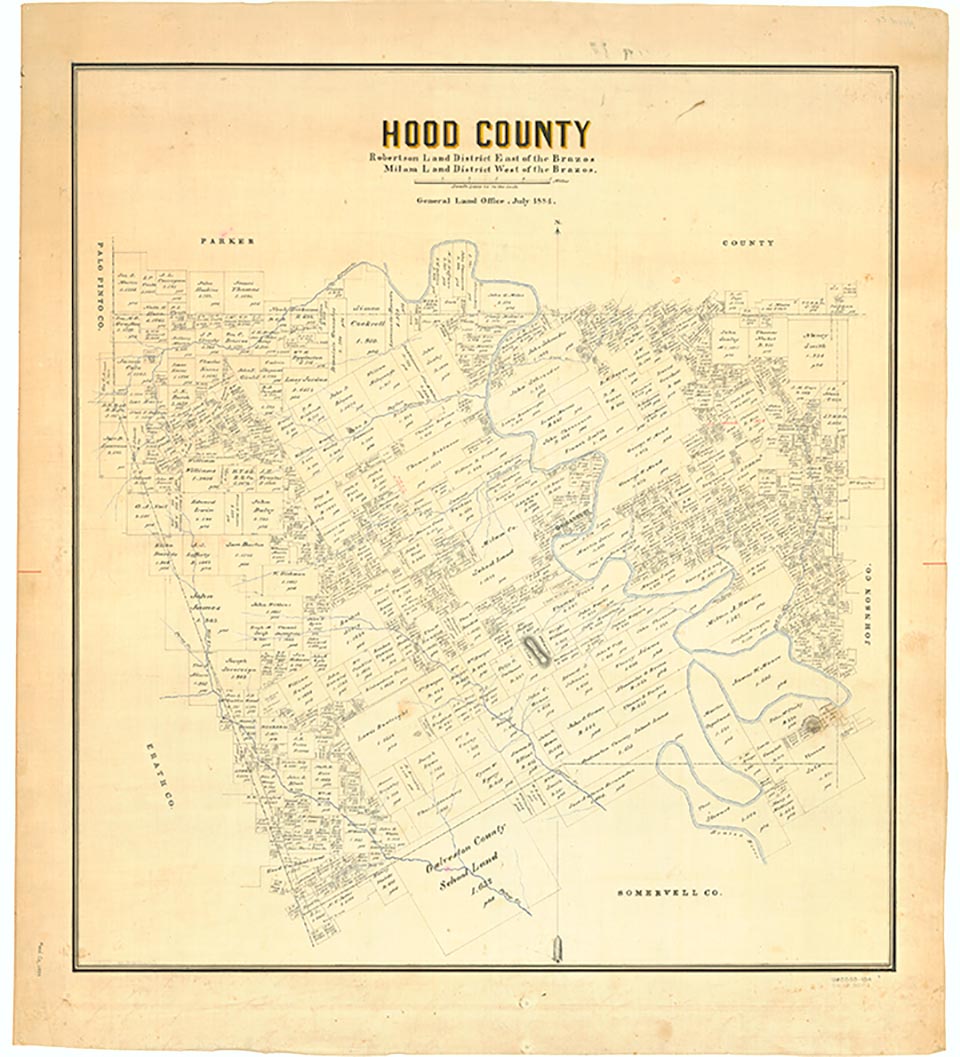
Acton is on State Highway 4 five miles east of Granbury in Hood County. The site was cleared in 1866, when the area was in Johnson County. Acton is the oldest known settlement in Hood County. As early as 1845 there were reports of surveyors working in the area. Among the first White settlers was Charles Barnard, who built a trading post on the Brazos River in order to trade with the nearby Indians. It was reported that the friendly Caddo Indians in the area assisted in the defense of the settlers against the fierce Comanches. In 1856 the settlement received a post office with the orthographically strange name Camanche Peak.
In 1855 a church building was built for use by Baptists, Methodists, Presbyterians, and "Reformed Christians"; each group used the structure once a month. That year Aaron Farris erected a water mill at nearby Walnut Creek. The mill became a natural gathering place for the townspeople, so Farris established a type of "exchange store" in his home. The first permanent store was built by Clarence Hollis. The building served the community as a general store, post office, saloon, and blacksmith shop. Soon, teacher William Wright began to conduct the first school in the area. The first local physicians, J. C. Cornelius and S. R. McPherson, arrived in 1855 and 1858, respectively. Construction on the Masonic Hall commenced, and upon its completion in 1868 many new families chose to settle permanently in Acton.
Around 1861 the townspeople were commissioned to select a new name for the area. Several suggestions were offered, but the permanent choice was Acton. There are several explanations for the new name. The most common is that Hollis proposed the name in honor of his sweetheart, Miss Acton. It was also suggested that the name was derived from Oak Town, due to the large number of oak trees growing in the area. The Acton post office was officially established in 1861 and operated until 1906. By 1903 it was on a daily delivery route out of Granbury.
During the mid-1850s Elizabeth Crockett, the second wife of David Crockett, and two of her sons settled on the David Crockett survey, 320 acres granted to the widow by the state of Texas. Upon her death she was buried in the Acton Cemetery. In 1911 the state placed a statue of her in the cemetery. The Crockett plot consists of .006 acres of land and was operated by the Texas Parks and Wildlife Department until operational control was transferred to the Texas Historical Commission in 2008. Acton State Historic Site holds the distinction of being the smallest state historic site in Texas.
By 1887 the population of Acton was estimated to be 200. It was 164 in 1927, 142 in 1933, and 75 from 1949 through the early 1960s. The 1970 tally, however, reached 210. The population increased because of the construction from the mid-1960s to 1970 of the De Cordova Bend Dam nearby. Upon completion of Lake Granbury the population leveled off once again at 130. Another surge in the population occurred by 1988, when it was 450; at this time the Comanche Peak Steam Electric Station was being constructed in nearby Somervell County. Acton is surrounded by farm and ranch land and has several residential subdivisions, in which new residents are employed by the nuclear plant. Three neighboring communities, Pecan Plantation, De Cordova Bend Estates, and Port Ridglea, are highly populated. In 1990 the population of Acton was still 450, and in 2000 it had grown to 1,129. That figure was still reported in the 2020s. A community center and library carries the town name. Acton Nature Center, which opened in the early 2000s, is a seventy-four-acre park that offers visitors hiking and biking trails, a 1930s farmhouse, and various educational programs about nature.
Bibliography:
Acton Nature Center of Hood County (https://actonnaturecenter.org/), accessed September 7, 2025. Acton State Historic Site, Texas Historical Commission (https://thc.texas.gov/historic-sites/acton), accessed September 4, 2025. Thomas T. Ewell, History of Hood County (Granbury, Texas: Gaston, 1895; rpt., Granbury Junior Woman's Club, 1956). C. L. Hightower, ed., Hood County in Picture and Story (Fort Worth: Historical Publishers, 1970; rpt. 1978). Vertical Files, Dolph Briscoe Center for American History, University of Texas at Austin. Welcome to Acton, Texas (https://actontx.com/), accessed September 7, 2025.
Time Periods:
The following, adapted from the Chicago Manual of Style, 15th edition, is the preferred citation for this entry.
Kristi Strickland, “Acton, TX,” Handbook of Texas Online, accessed March 09, 2026, https://www.tshaonline.org/handbook/entries/acton-tx.
Published by the Texas State Historical Association.
TID:
HLA03
All copyrighted materials included within the Handbook of Texas Online are in accordance with Title 17 U.S.C. Section 107 related to Copyright and “Fair Use” for Non-Profit educational institutions, which permits the Texas State Historical Association (TSHA), to utilize copyrighted materials to further scholarship, education, and inform the public. The TSHA makes every effort to conform to the principles of fair use and to comply with copyright law.
For more information go to: http://www.law.cornell.edu/uscode/17/107.shtml
If you wish to use copyrighted material from this site for purposes of your own that go beyond fair use, you must obtain permission from the copyright owner.
- 1952
- September 7, 2025
This entry belongs to the following special projects: