Josefa Becerra: A Pioneering Tejano Woman in Texas History (ca. 1790–1849)
Published: October 11, 2023
Updated: October 22, 2025
María Josefa Agustina Becerra, more commonly Josefa Becerra, was the wife of Erasmo Seguín, prominent San Antonio political and business leader, and mother of Juan Nepomuceno Seguín, leading Tejano military figure during the Texas Revolution. She was born at La Bahía del Espíritu Santo about 1790 and was the daughter of Miguel Becerra, also a La Bahía native, who enlisted at the presidio there in 1776, and the granddaughter of Pedro Becerra, a Louisiana native who served at La Bahía from the 1750s and retired there before 1780. Nothing is known of Josefa’s mother, Bárbara Sánchez Navarro. Between 1806 and 1809 Josefa gave birth to three children. Juan was born in 1806, Tomás was born in 1807 but died the following year, and María Leonides was born in 1809. Despite her father’s and grandfather’s humble origins as enlisted men, Josefa learned to read and write and claimed to have brought the substantial sum of 6,600 pesos into her marriage to Erasmo Seguín as her dowry.
Josefa Becerra was a resourceful and talented woman whose support of her husband began early in their marriage. She helped obtain Erasmo’s release after his arrest by the insurgents of the Gutiérrez-Magee expedition following their capture of San Antonio in April 1813. Later, when the family’s property was confiscated by the royalists and Erasmo was charged with treason, she worked with La Bahía postmaster Bernardo Amado in an attempt to recover at least half of the property, all of which she claimed had been acquired during their marriage. In lieu of half of their marriage wealth, she asserted that she and her children were at least entitled to the dowry she had brought to the marriage. During Erasmo’s service as Texas representative to the constituent congress that produced the federal Constitution of 1824, he left San Antonio’s post office in her charge, although their son Juan, still a teenager, served as the public face of the office. During Erasmo’s absence she wrote to Austin on his behalf, expressing the hope of going to visit Austin and family at San Felipe on his return. Erasmo’s correspondence with Josefa makes clear that he trusted her judgment and management of family affairs. Aside from post office matters, Josefa managed the family’s farming operations, including the hiring of laborers, renting of oxen, and acquisition of irrigation water.
As the wife of a prominent member of the community, she managed a household that from an early date included various free and enslaved servants and would have hosted visitors and guests. She probably had a say in the Seguíns’ decision to take in Stephen F. Austin’s brother James, so he could learn Spanish from the family. Although no evidence survives, it is likely that Josefa would have overseen balls that brought the town’s elite together. Her correspondence with Erasmo during his absence in Mexico City during 1823–25 makes clear that women like Josefa were very much capable of acting as heads of complex households, although custom and law prevented them from participating in governmental and political activities.
Josefa Becerra suffered through two periods of warfare in San Antonio. Present during the town’s capture by Bernardo Gutiérrez de Lara and the Republican Army of the North in April 1813, she and the children would have witnessed the defeat of the republicans at the hands of Gen. Joaquín Arredondo at the battle of Medina in August of that year. As the wife of a known royalist, she would have been spared the fate of many of the Bexareñas whose husbands had participated in the rebellion. Many of those women were confined at a confiscated house called La Quinta, where they were forced to make tortillas for the royalists. Worse yet, many of them had to witness the execution of their captured husbands and sons, and in some cases suffer physical and sexual violence. In fall 1835 she remained behind in San Antonio when Gen. Martín Perfecto Cos exiled Erasmo to his ranch. According to her son Juan’s memoirs, she was in San Antonio during the siege of Béxar that culminated in the town’s capture by Texans in December. She then participated in the Runaway Scrape, as Erasmo took charge of moving his family, Juan’s, and other related families to East Texas ahead of Santa Anna’s advancing army.
Becerra fades from the record after 1836 except for serving as a witness at the wedding of her goddaughter María del Carmen Seguín to Ira Hewitt, in 1845, and as godparent along with Erasmo to her granddaughter María Gertrudes Flores in 1846. That year saw Capt. Jefferson Peak of the U. S. Army stop at the Seguín homestead on his way to Port Lavaca. His account, though unflattering—he referred to Josefa as an “old hag” at one point—makes clear that, now in her mid-fifties, she remained an assertive woman with an apparent dislike for Anglo Americans and a willingness to challenge unreasonable demands. According to Peak, she at first refused to serve him breakfast and screamed and had to be restrained from going at him after he killed one of her chickens. Josefa Agustina Becerra was buried in San Antonio on September 27, 1849, having lived long enough to see her son Juan return from his exile in Mexico.
Bibliography:
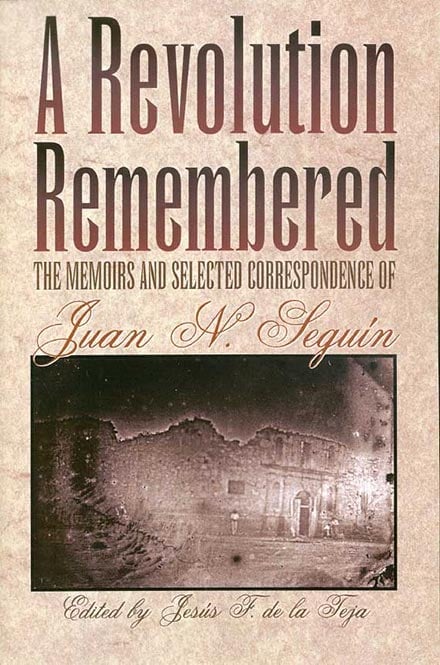
Eugene C. Barker, ed., The Austin Papers (3 vols., Washington: GPO, 1924–28). Bradley Folsom, Arredondo: Last Spanish Ruler of Texas and Northeastern New Spain (Norman: University of Oklahoma Press, 2017). Jesús F. de la Teja, ed., A Revolution Remembered: The Memoirs and Selected Correspondence of Juan N. Seguín (2nd ed., Austin: Texas State Historical Association, 2002). Jesús F. de la Teja, “The Treason Case of Erasmo Seguín: A Story of Texas’s First War of Independence,” Southwestern Historical Quarterly 126 (July 2022). Richard Bruce Winders, Queen of the West: A Documentary History of San Antonio, 1718-1990 (Kerville: State House Press, 2021).
Categories:
Time Periods:
Places:
The following, adapted from the Chicago Manual of Style, 15th edition, is the preferred citation for this entry.
Jesús "Frank" de la Teja, “Becerra, María Josefa Agustina,” Handbook of Texas Online, accessed March 09, 2026, https://www.tshaonline.org/handbook/entries/becerra-maria-josefa-agustina.
Published by the Texas State Historical Association.
TID:
FBEMJ
- October 11, 2023
- October 22, 2025
This entry belongs to the following special projects: