History of Camp Colorado: A Military Post in Texas
Published: 1952
Updated: September 11, 2019
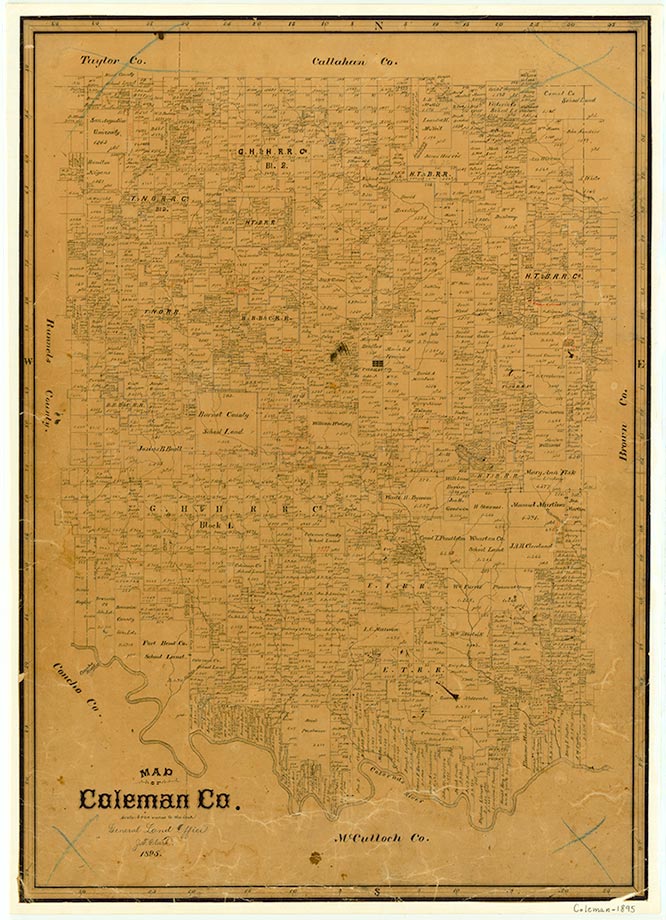
In 1855 Camp Colorado was probably temporarily at a site near what is now Ebony, in Mills County. In August 1856, Troops A and F and United States Cavalry under Maj. Earl Van Dorn moved the camp to Mukewater Creek about six miles north of the Colorado River, on the route between Fort Belknap and Fort Mason in Coleman County. Because of sickness among the soldiers, the post was moved in July 1857 about twenty-two miles north to Jim Ned Creek. Commanders who succeeded Van Dorn included Edmund Kirby Smith, Lawrence S. (Sul) Ross, John Bell Hood, and Fitzhugh Lee. Robert E. Lee visited the camp at least twice on tours of inspection. From 1857 to 1861 Camp Colorado was the center of Coleman County's settlements. The camp's buildings were of adobe with shingled roofs and pine-plank floors; the lumber, doors, and windows were hauled by ox team from East Texas. Outside communication was through a post office and a telegraph line along the Wire Road between the camp and army headquarters at San Antonio. People settled at all of the nearby waterholes. In 1857, J. C. Mullins, a graduate of Yale University, settled east of the camp and taught school under an elm tree on the post.
The camp was abandoned on February 26, 1861, by order of Gen. David E. Twiggs. With the exception of Lt. George B. Cosby, the men stationed at the camp all went into Confederate service. After the departure of United States troops, Capt. W. Pitts and later Capt. James Monroe Holmsley commanded companies of state troops at the camp until early in 1862. From 1862 to 1864 Capt. J. J. Callan and a company of Texas Rangers occupied the post. Texas state troops occupied the post until the end of the Civil War. Camp Colorado was not regarrisoned by United States troops after its evacuation by the Confederates. Fourteen years after the Civil War an Englishman, H. H. Sackett, purchased the land in the vicinity of the old post. The headquarters building was dismantled, and the stone was used to build a combination store and residence. Leaving the guardhouse intact, Sackett attached one wall of the residence to it. A stretch of stone corral fence remains, and a quarter of a mile to the east is the post cemetery.
Bibliography:
Beatrice Grady Gay, Into the Setting Sun: A History of Coleman County (Coleman?, Texas, 1936?). Thomas R. Havins, "The Texas Mounted Regiment at Camp Colorado," Texas Military History 4 (Summer 1964). Joseph Carroll McConnell, West Texas Frontier (Vol. 1, Jacksboro, Texas, 1933; Vol. 2, Palo Pinto, Texas, 1939). Robert B. Roberts, Encyclopedia of Historic Forts: The Military, Pioneer, and Trading Posts of the United States (New York: Macmillan, 1988).
Time Periods:
The following, adapted from the Chicago Manual of Style, 15th edition, is the preferred citation for this entry.
Beatrice Grady Gay, “Camp Colorado,” Handbook of Texas Online, accessed March 09, 2026, https://www.tshaonline.org/handbook/entries/camp-colorado.
Published by the Texas State Historical Association.
TID:
QBC08
- 1952
- September 11, 2019