History of Cisco, Texas: From Frontier Settlement to Historical District
By: Noel Wiggins
Published: 1952
Updated: September 20, 2023
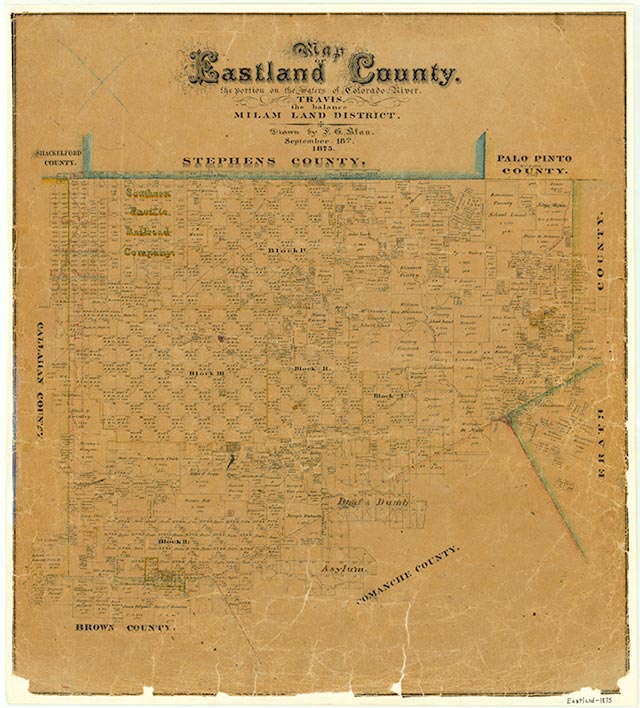
Cisco, at the intersection of U.S. Highway 183 and Interstate Highway 20, in northwestern Eastland County, traces its history back to 1878 or 1879, when Rev. C. G. Stevens arrived in the area, established a post office and a church, and called the frontier settlement Red Gap. About six families were already living nearby, and W. T. Caldwell was running a store a half mile to the west. In 1881 the Houston and Texas Central Railway crossed the Texas and Pacific, which had come through the year before, at a point near Red Gap, and the settlement's inhabitants moved their town to the crossing. Three years later the town was officially recognized and a new post office granted; the town's name was changed to Cisco for John A. Cisco, a New York financier largely responsible for the building of the Houston and Texas Central.
Railroads continued to influence the development of Cisco as the Texas and Pacific acquired lots in the town and sold them to immigrants attracted by brochures touting the town as the "Gate City of the West" and promising half fares and generous baggage service for all settlers. Once settlers arrived, agricultural agents employed by the railroad advised them what and when to plant and on occasion provided the seed. During the 1880s a Mrs. Haws built and managed the first hotel, and Mrs. J. D. Alexander brought the first "millinery and fancy goods" to town. Following a practice common at the time, religious groups in Cisco met together for prayer meetings in the schoolhouse until they could build separate churches. By 1892 Cisco was a growing community with two newspapers, a bank, and an economy based on trade, ranching, fruit farming, and the limestone, coal, and iron ore available nearby. A broom factory and roller corn and flour mills were among the town's fifty-six businesses. But in 1893 a tornado hit Cisco, killing twenty-eight people and destroying or damaging most of its homes and businesses. Sources note that Mayor Conner of Dallas impressed fifty Blacks to help clean up the wreckage in Cisco, and that among those whose businesses were affected was a Chinese laundryman.
Although Cisco played a relatively minor role in the Eastland County oil boom of 1919–21, its population grew rapidly at the time, with some estimates as high as 15,000; in the wake of the boom Cisco adopted a city charter and built a new railroad station that cost $25,000. Cisco was also in the background of a heated controversy between the Ku Klux Klan and its opponents that swept the county in the early 1920s (see RANGER, TEXAS). A Klan newsletter noted that Klan and anti-Klan forces had agreed to cease hostilities at Cisco, a fact that suggests a certain level of Klan activity in the town.
Probably the best-known event in Cisco history was the Santa Claus Bank Robbery. It occurred two days before Christmas of 1927, when four men robbed the First National Bank, taking $12,000 in cash and $150,000 in nonnegotiable securities. A chain of exciting events-including an attempt to steal a car foiled by a quick-thinking fourteen-year-old and a gun battle in which three people were killed, seven were injured, and two young girls were kidnapped-accounts for the many, often melodramatic, stories written about the robbery. One of the bandits eventually died of gunshot wounds, one served a prison sentence and was released, one died in the electric chair, and the last was lynched after shooting a jailer while trying to escape.
In the years following World War II, Cisco became increasingly dependent on oil and gas production, agriculture (primarily peanut culture), and manufacturing. Cisco Junior College grew and was enrolling around 1,000 students in the early 1980s. In 1980 Cisco had a population of 4,517 and 154 businesses. That year residents applied to have the whole town named a historical district. They were inspired to seek recognition by a University of Houston professor who had come to Cisco to supervise the restoration of the Mobley Hotel, the first hotel owned by hotel magnate Conrad Hilton. In 1990 the population of Cisco was 3,813.
Bibliography:
Edwin T. Cox, History of Eastland County, Texas (San Antonio: Naylor, 1950). Fort Worth Star-Telegram, March 12, 21, 1967. Ruby Pearl Ghormley, Eastland County, Texas: A Historical and Biographical Survey (Austin: Rupegy, 1969).
Places:
The following, adapted from the Chicago Manual of Style, 15th edition, is the preferred citation for this entry.
Noel Wiggins, “Cisco, TX,” Handbook of Texas Online, accessed March 09, 2026, https://www.tshaonline.org/handbook/entries/cisco-tx.
Published by the Texas State Historical Association.
TID:
HGC06
- 1952
- September 20, 2023