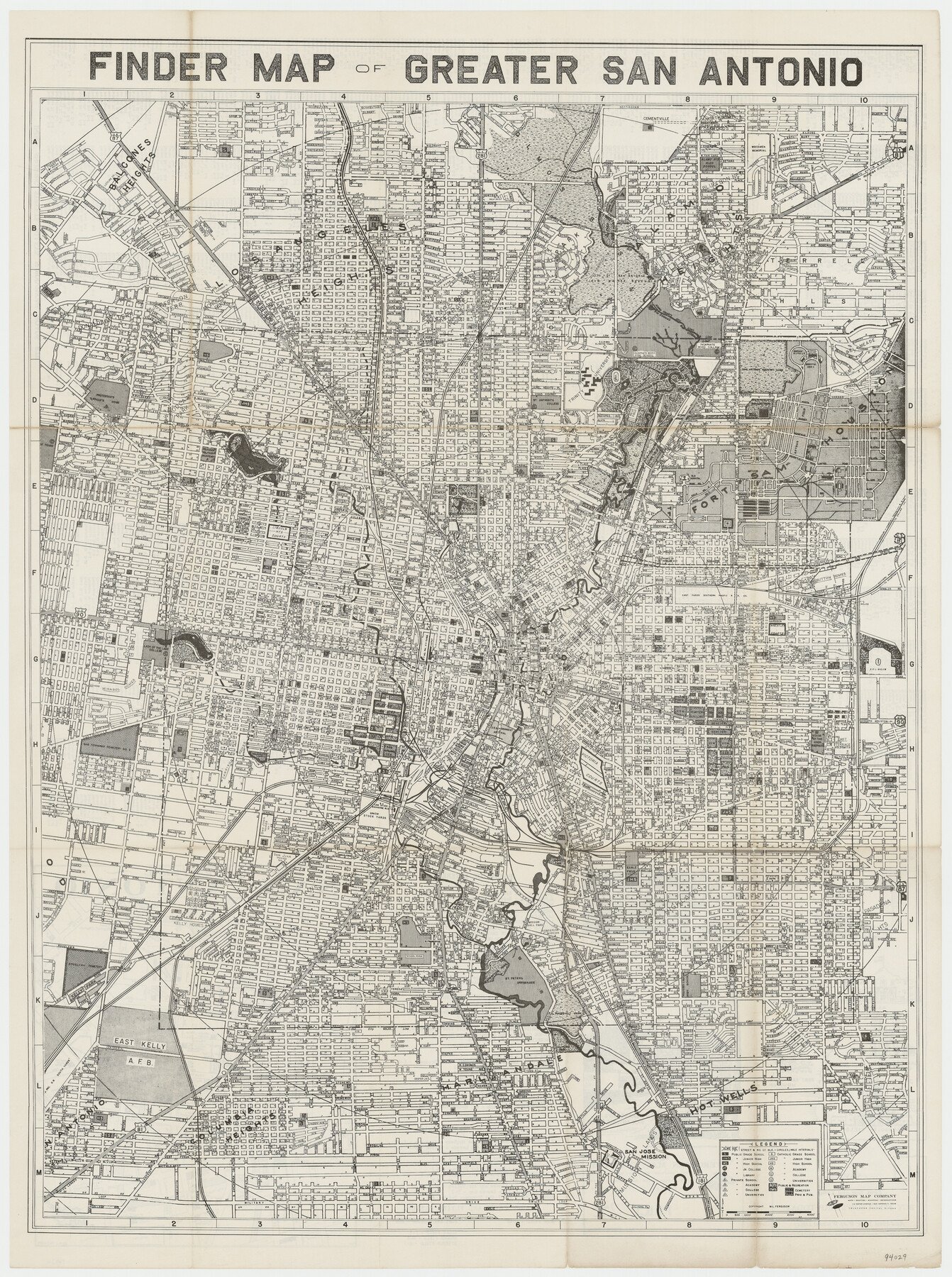
History of San Antonio Water Works Company
By: Lewis F. Fisher
Published: April 17, 2024
Updated: April 17, 2024
The privately-owned San Antonio Water Works Company, later known as the San Antonio Water Supply Company, Water Company of San Antonio, and Water Supply Company, began operations in 1878 and provided San Antonio its main source of water for nearly fifty years. Before that, the city had depended on an increasingly inadequate Spanish-era network of gravity-driven acequias or irrigation ditches. Attempts to establish a more effective water supply were made in 1858 and 1860 but to no avail. But with a railroad coming and major growth certain to follow, under reform mayor James H. French the city at last faced the need to enable water to be pumped uphill.
In April 1877, two months after being linked by rail with Houston, the city chose the new San Antonio Water Works Company, headed by Jean Batiste LaCoste, to build and operate the system. Eight years before, LaCoste had acquired the city’s first ice-making plant, beside the San Antonio River on Losoya Street. Company secretary was William R. Freeman, a local civil and hydraulic engineer who designed water systems in Kansas City and Austin, and treasurer was S. A. Oliver, local representative of King Iron Bridge and Manufacturing Company of Cleveland, Ohio. Initial stock for the company totaled $100,000.
Freeman supervised construction by Oliver’s company of a stylish two-level pump house of stone quarried nearby. The pump house straddled the end of a 650-foot raceway that diverted water from the San Antonio River at the northern end of what is now Brackenridge Park. As it entered the lower level of the pump house before emptying back into the river, the raceway spun water through two turbines—basically horizontal waterwheels—up to power two pumps at the upper level. They pumped the water a mile east to a hilltop stone reservoir, now partly filled and used as an amphitheater by the San Antonio Botanical Garden. Water was piped on to San Antonio homes and businesses below. Water Works operation began on July 3, 1878. LaCoste diverted excess water into a frame building adjoining the pump house he used as a small ice plant and installed a machine that piped ammonia-based freezing fluids around steel boxes holding water.
But too many San Antonians were initially reluctant to pay for water from the new system, and Water Works revenues fell short of projections. Banker George W. Brackenridge traded LaCoste loans for stock in the company. In 1880 Brackenridge owned a majority of the stock and was president of the company. In 1883 he owned all the stock, then valued at $500,000 and LaCoste was gone, as was the pump house’s adjoining ice operation. As San Antonio’s population doubled, Brackenridge’s company dug a new raceway from the river west of the 1878 pump house a mile straight south to a second two-level pumphouse, which pumped three million gallons a day up to the reservoir, more than doubling the capacity of the first pump house.
As new artesian wells lowered the water table and decreased the flow of the river, the San Antonio Water Works Company began drilling its own artesian wells. Most successful was a well at Market Street and the river, where Brackenridge built a pumping station drawing from wells that are still in use. As artesian wells replaced the river to become the company’s main water supply, through his company Brackenridge gave the nearly 200 acres of Water Works land along the river to the city to become Brackenridge Park, reserving some water and land rights for the company.
In 1906 Brackenridge sold the Water Works Company to a group of St. Louis investors headed by streetcar manufacturer George J. Kobusch. They reincorporated as the San Antonio Water Supply Company. In 1910 the St. Louis group sold 90 percent of their stock to an Antwerp-based Belgian syndicate, which changed the name to Compagnie des Eaux de San Antonio, or Water Company of San Antonio. Germany’s invasion of Belgium in 1914 disrupted communications with the remaining St. Louis shareholders, who used accumulating surplus funds to meet San Antonio’s ever-increasing needs with a pumping station and new wells on reserved land near the former second pump house in Brackenridge Park. The Brackenridge Park pumping station was completed in 1915 with a pump pit forty-five feet deep and a power plant nearby. It augmented the Market Street station with a similar pumping capacity—twenty million gallons—but now pumped directly to users. The two pump houses in Brackenridge Park and the stone reservoir up the hill were no longer needed.
In 1920 members of the Belgian syndicate, needing funds to rebuild their country following World War I, sold most of their stock to San Antonio investors led by E. B. Chandler and A. S. Gage and later purchased the remaining stock under the name Water Supply Company. A third pumping plant was opened south of downtown in 1922 to provide an auxiliary supply of up to six million gallons a day as needed. In 1925 the company was sold for a total of $6.5 million to the city of San Antonio and began operating under public ownership, which continues.
Bibliography:
Documentary History of American Water-works: San Antonio, Texas (http://www.waterworkshistory.us/TX/San_Antonio/), accessed April 6, 2024. Lewis F. Fisher, Brackenridge: San Antonio’s Acclaimed Urban Park (San Antonio: Trinity University Press, 2022). Bert J. McLean, The Romance of San Antonio’s Water Supply and Distribution (San Antonio: Water Supply Co., 1927).
Categories:
Time Periods:
Places:
The following, adapted from the Chicago Manual of Style, 15th edition, is the preferred citation for this entry.
Lewis F. Fisher, “San Antonio Water Works Company,” Handbook of Texas Online, accessed March 09, 2026, https://www.tshaonline.org/handbook/entries/san-antonio-water-works-company.
Published by the Texas State Historical Association.
TID:
DPSAN
All copyrighted materials included within the Handbook of Texas Online are in accordance with Title 17 U.S.C. Section 107 related to Copyright and “Fair Use” for Non-Profit educational institutions, which permits the Texas State Historical Association (TSHA), to utilize copyrighted materials to further scholarship, education, and inform the public. The TSHA makes every effort to conform to the principles of fair use and to comply with copyright law.
For more information go to: http://www.law.cornell.edu/uscode/17/107.shtml
If you wish to use copyrighted material from this site for purposes of your own that go beyond fair use, you must obtain permission from the copyright owner.
- April 17, 2024
- April 17, 2024